
Keep the intelligence local.
Our design puts thermal processing at the edge, with the goal of keeping monitoring and defined local alerts independent of internet availability.
Local-first designSentinel / Edge thermal monitoring
A clearer view of developing thermal hazards. We’re building Sentinel to bring local detection, site-specific configuration, and verifiable evidence to industrial monitoring.
In development. Exploring fit with prospective pilot partners.
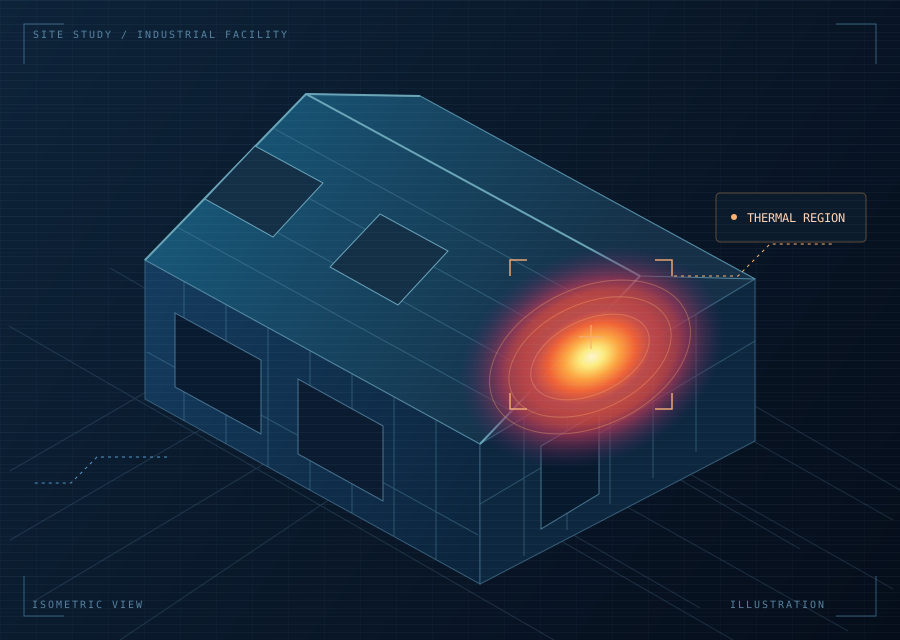
Intelligence on site.
Context in every event.
01 / The platform
A hot region is a starting point. Understanding what it means requires the right configuration, an operating workflow, and a way to check the system is doing its job.
Our design puts thermal processing at the edge, with the goal of keeping monitoring and defined local alerts independent of internet availability.
Local-first designStart with supported cameras and a defined hazard. Shape configuration around operating conditions, expected activity, and the team’s response.
Site-specific approachEvaluate against representative footage, normal activity, and failure conditions. Document the results and limits of the tested configuration.
Our validation approachA local monitoring workflow
Proposed deployment architecture
Remote access and notifications depend on their connectivity path. Offline behavior and local outputs must be verified for each deployment.
02 / Where it could fit
Our initial focus is industrial fire-risk monitoring. We’re exploring these environments to understand where a measured pilot could add value.
Discovery areas, not validated application claims. Suitability depends on the hazard, visibility, sensor, and operating conditions.
Explore developing hot spots alongside moving vehicles, changing material, and hot equipment. A useful evaluation must include the site’s ordinary activity.
Discuss this environmentInvestigate abnormal heating against known operating patterns. Define whether the requirement is fire-risk monitoring, equipment monitoring, or both.
Discuss this environmentAssess whether visible surface heating provides useful information for the specific battery application. Thermal visibility and warning time must be established, not assumed.
Discuss this environment03 / Evidence before promises
That’s the right question.
It should shape the whole deployment.
Our proposed evaluation compares a defined configuration against real conditions and an agreed baseline. Useful results include the failures, not just the successes.
Explore the validation frameworkTarget events and ordinary operations. Camera settings, visibility, and coverage documented.
Missed events, nuisance alerts, detection delay, availability, and alert delivery measured separately.
Lost connections, frozen video, process restarts, and storage limits included in evaluation.
Agree the scope before testing. Record results, versions, and limitations before deciding to deploy.
04 / A considered path
We’re exploring a commissioned solution with supported hardware and ongoing maintenance. Every engagement starts with understanding the site.
Discuss your hazard, cameras, current monitoring, response process, and what would make an evaluation useful.
Agree supported inputs, deliverables, responsibilities, costs, and acceptance criteria before installation.
Use documented results to decide whether to deploy, revise the scope, or stop. Fit matters more than forcing a rollout.
Proposed commercial model: assessment and pilot, deployment and commissioning, then an annual software and support agreement. Pricing depends on site scope and supported camera configuration.
05 / Practical questions
Considering Sentinel for your site?
Here’s where the conversation starts.
Your existing camera may already meet your needs. We want to evaluate whether site configuration, verification, event context, and the operating workflow add measurable value beyond its built-in analytics.
Local operation is a core design objective. Each pilot must verify the exact offline scope, including detection, recording, local access, and local outputs. Remote notifications, fleet synchronization, and remote support depend on their connectivity path.
No universal compatibility is claimed. Support depends on the model, firmware, stream settings, and required data. A rendered thermal video feed is not automatically a source of calibrated temperature measurements. Compatibility is assessed before a deployment is proposed.
No replacement or certification claim is established. Sentinel’s role, interfaces, and limitations must be agreed alongside existing site safety arrangements and applicable requirements.
Sentinel is in development. We welcome site-fit and prospective pilot conversations. Pilot availability depends on technical readiness and a mutually agreed scope; submitting an enquiry does not reserve installation capacity.
The site’s agreed response team follows its established procedures. No emergency response or staffed monitoring service is included unless separately agreed.
Let’s find out what fits
Tell us what you monitor today, where the uncertainty is, and what you need to verify. We’ll start there.
info@speetu.comStart a site conversation
Prepare an enquiry below. We’ll open your email app with the details so you can review and send it.